
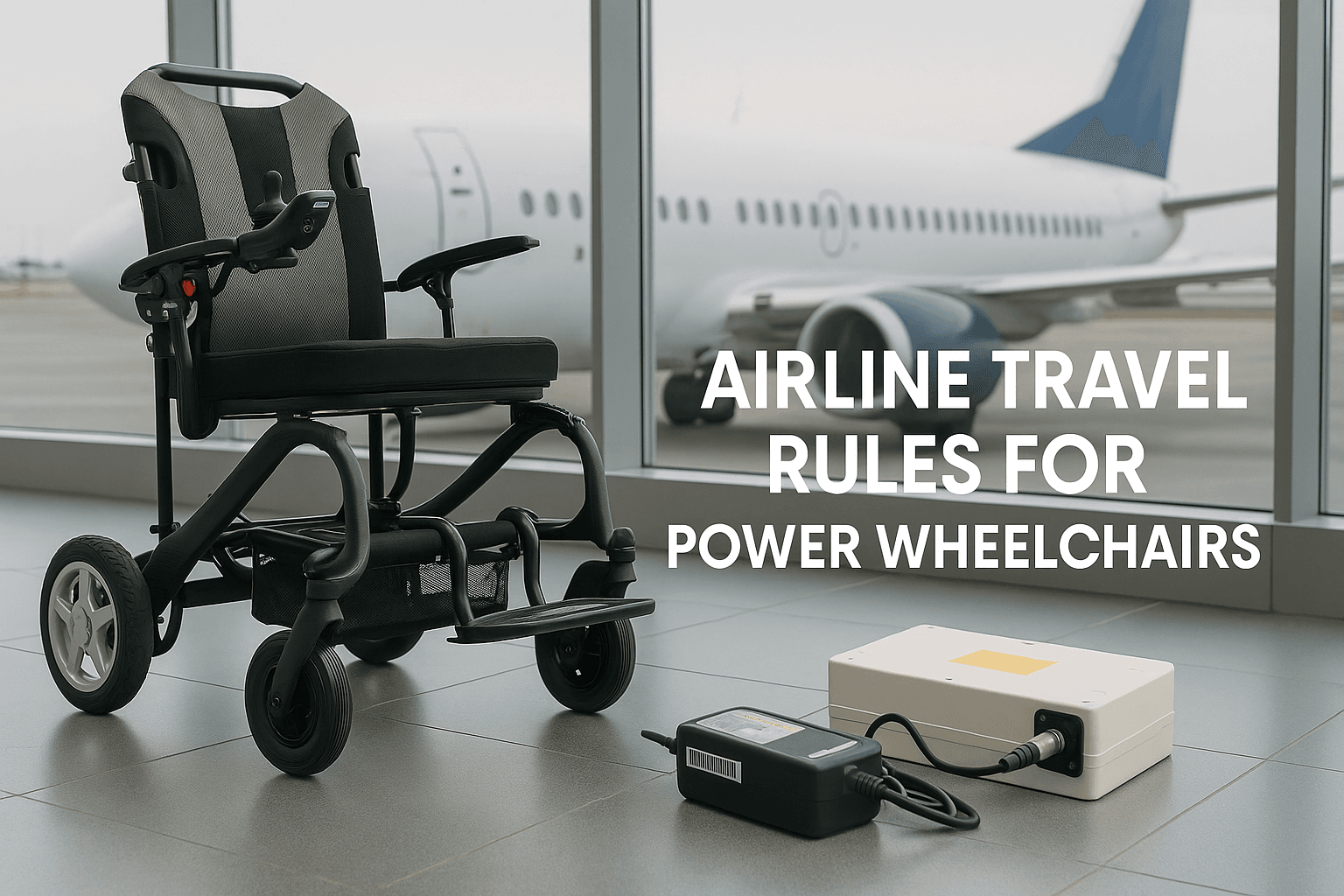
Airline Travel Rules for Power Wheelchairs 2025 Guide
Flying with a powered chair is absolutely doable in 2025 when you plan around batteries, advance notice, and aircraft handling procedures. Below is a practical, airline-aligned checklist you can use for U.S. and U.K. trips, with pointers to confirm details before you book. For product fit and documentation support, UltimatePointCare provides clear specs and responsive after-sales service—see the brand story on the about us page.
Airline travel wheelchair essentials you must confirm
- Battery type, size, and spares. In the U.S., FAA PackSafe sets the baseline: most lithium-ion wheelchair batteries are allowed up to 300 Wh if the battery isn’t in a protective housing; you may carry one spare ≤300 Wh or two spares ≤160 Wh each in the cabin, with terminals protected from short circuit. Lithium-metal batteries are not allowed for powered chairs. Always carry watt-hour labels or spec sheets and protect power leads from activation.
- Device preparation. IATA guidance requires preventing unintentional activation, protecting terminals, and securing batteries according to type (installed vs removed). Keep a simple “gate card” describing how to disconnect and lift your chair. 国际航空运输协会
- Your rights if things go wrong. The U.S. DOT strengthened ACAA rules in 2024–2025 to address mishandled wheelchairs/scooters and unsafe transfers, tightening carrier obligations around stowage, assistance, and damage handling. Know these rules—they help during check-in and after landing if service falls short.
- Bookable categories for equipment. Many carriers will pre-tag your chair at the gate. Bring printed dimensions, battery Wh, instructions to disconnect, and tool/strap locations. When browsing chairs suited for flying, start with airline travel wheelchair and air travel wheelchair collections to compare fold size and battery documentation readiness.
Air travel wheelchair planning timeline (U.S. and U.K.)
- 72–48 hours before departure: Notify the airline of your powered mobility device, battery type/Wh, and assistance needs (aisle chair, transfer help, pre-boarding). U.K. CAA guidance encourages advance notice and explains airport assistance and how mobility aids are handled—use it as your pre-flight checklist.
- Day of travel: Arrive early to allow gate tagging, battery checks, and pre-boarding. Attach contact info to your chair and photograph condition/settings before handover. Ask staff to stow upright when possible and to avoid lifting by armrests or joysticks.
Snapshot of U.K. airline practices (verify per flight)
- British Airways. Provides disability assistance and details battery handling by chemistry; some small aircraft (e.g., BA CityFlyer) have weight/size limits that can affect carriage. Always pre-clear your model and battery type.
Snapshot of U.S. airline practices (verify per flight)
- American Airlines. Requests travelers with battery-operated mobility devices contact Special Assistance to confirm battery type/approval and coordinate handling, especially on codeshares. Clear labeling and reachable contact info on the chair speed things up at the gate.
- Policy changes happen. U.S. carriers periodically update lithium-battery procedures; keep an eye on airline notices and news (e.g., some carriers announced tighter removable-battery handling in late 2025). Always reconfirm limits and removal procedures after booking.
Packing and paperwork for airline travel wheelchair users
- Documents: Printed battery specs (Wh), a one-page disconnect guide, photos of chair condition, and your assistance request confirmation.
- Protection: Bubble-wrap or foam for joystick/controls, terminal caps, Velcro/zip ties to secure cables, and a small tool kit.
- Spare power: If your design allows a spare cabin battery (within FAA limits), pack it with terminals taped/covered in a rigid case and declare it at security.
At the airport and onboard: practical flow
- Check-in: Reconfirm assistance, chair dimensions, and battery details. Ask for gate check with manual push mode demonstrated.
- Security: Carry spares in your hand luggage; keep labels visible.
- Boarding: Pre-board for an unhurried transfer via aisle chair. Remind crew of secure stowage and NOT to lift by removable parts.
- Arrival: Inspect the chair at the jet bridge. If damaged or not functioning, file an ACAA complaint on the spot and request immediate assistance; recent DOT rules strengthen remedies for mishandling.
Choosing equipment that flies well
If air travel is frequent, prioritize: (1) clear battery labeling (Wh), (2) tool-free battery removal, (3) folded size that suits smaller holds, and (4) published disconnect steps. When shopping, compare models and documentation readiness in the central airline travel wheelchair and air travel wheelchair hubs. For ongoing support, UltimatePointCare’s service and parts access help keep chargers, tires, and batteries aligned with airline requirements through the year.